
Mental Health Toolbox

Wellbeing Tools
Here are the best Mental Health and Wellbeing tools to build your positive mental health and resilience.
Try out a few tools in the Toolbox below. It has 4 sections covering mental, spirit, social and physical.
The tools are from Acceptance and Commitment Therapy, Dialectical Behaviour Therapy and evidence-based Wellbeing strategies and peer reviewed by a registered psychologist.
Disclaimer: The information on this website is NOT a substitute for proper diagnosis, treatment or the provision of advice by an appropriate health professional.
Click on one of the toolbox areas below:
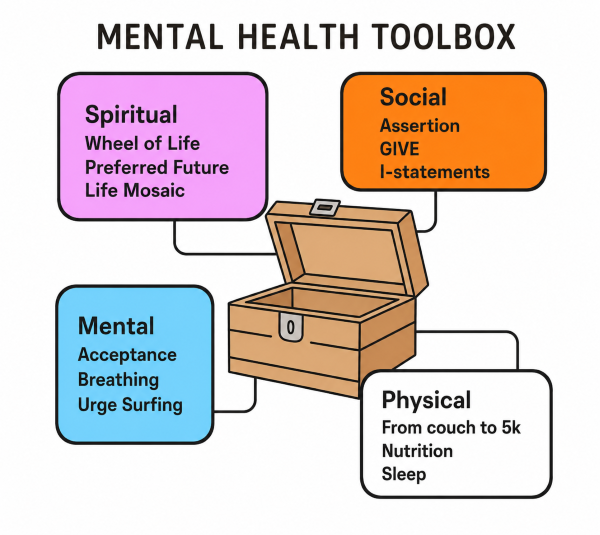
Mental Health Skills
Taha Hinengaro
Spirit & Strengths
Taha Wairua
Social Skills
Taha Whānau
Physical Wellbeing
Taha Tinana
If you’re feeling too stressed or numb to think straight, try these calming and grounding tools
The Toolbox
Mental & Emotional – Taha Hinengaro
Techniques
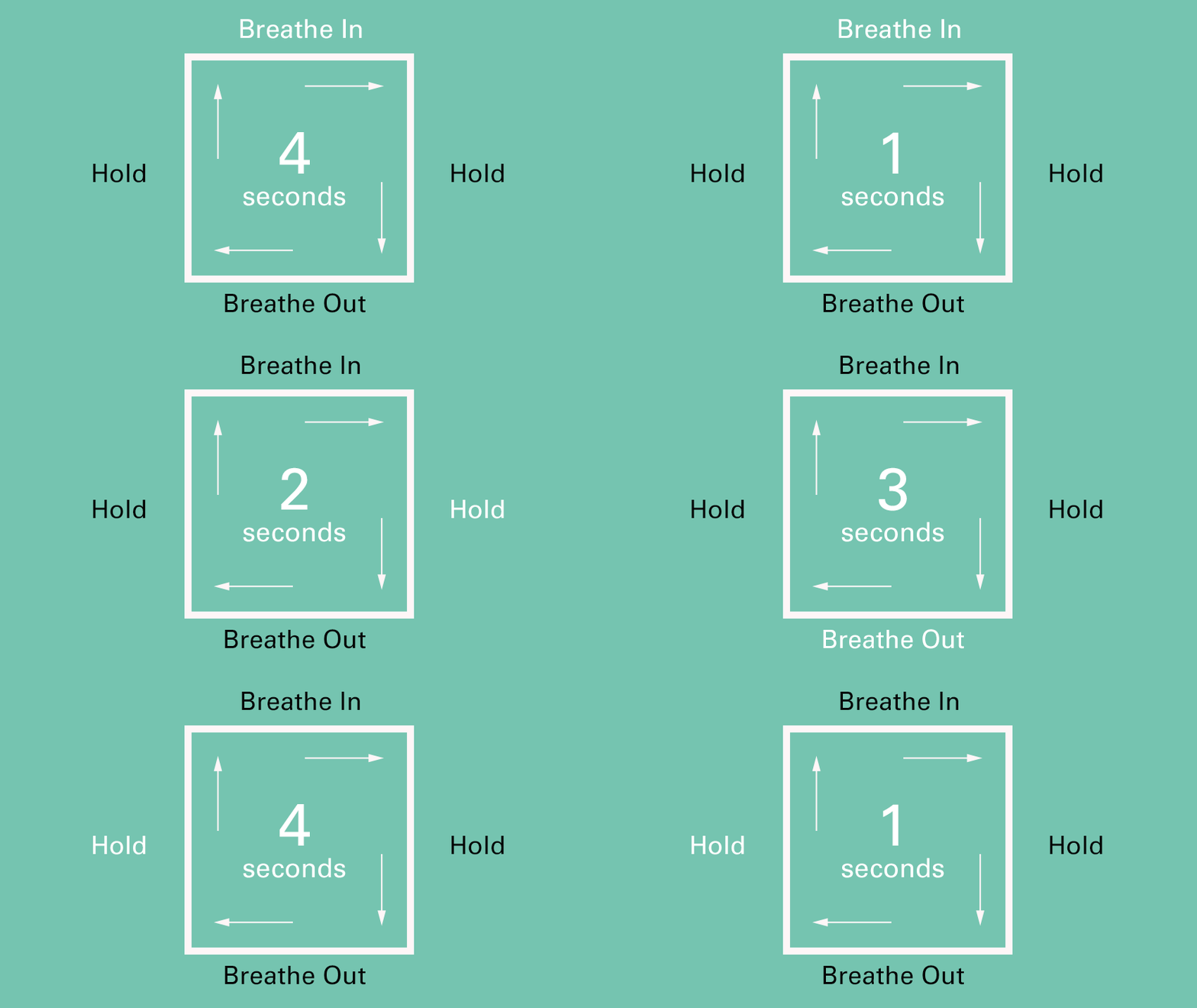
Box Breathing
Box breathing is a simple, four-step stress-reduction technique that involves inhaling, holding, exhaling, and holding again, each for a count of four. This 16-second cycle stabilizes breathing, lowers heart rate, and triggers the parasympathetic nervous system, making it an effective, portable tool for calming the mind and body in high-stress situations
Here’s how to do it:
- Breathe in for 4 seconds
- Hold for 4 seconds
- Breathe out for 4 seconds
- Hold for 4 seconds
- Repeat 4 times
5 4 3 2 1 Grounding
You can use this coping technique with anyone who is feeling anxious. It helps them to regain focus on the present situation, calming them down.
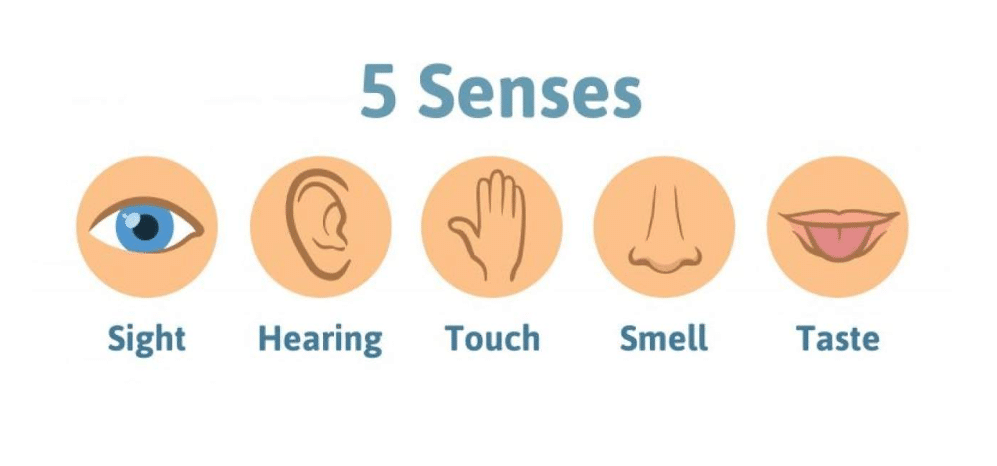
This grounding technique uses your five senses to focus on the moment you are in and helps you to avoid anxious or stressful thoughts that might make the situation worse.
Example
Youthliner “Excellent. This exercise is called 5-4-3-2-1 technique. It only takes a minute. Follow my instructions...
Start with a big belly breath, then
5: Acknowledge FIVE things you see around you. It could be a pen, a spot on the ceiling, anything in your surroundings.
4: Acknowledge FOUR things you can touch around you. It could be your hair, a pillow, or the ground under your feet.
3: Acknowledge THREE things you hear. This could be any external sound. If you can hear your belly rumbling that counts! Focus on things you can hear outside of your body.
2: Acknowledge TWO things you can smell. Maybe you are in your office and smell pencil, or maybe you are in your bedroom and smell a pillow. If you need to take a brief walk to find a scent you could smell soap in your bathroom, or nature outside.
1: Acknowledge ONE thing you can taste. What does the inside of your mouth taste like—gum, coffee, or the sandwich from lunch?
Okay, that's it. How'd you find it?"
Review the technique in this video
Panic Attacks
A panic attack is a sudden episode of intense fear or discomfort that triggers severe physical reactions—such as a racing heart, shortness of breath, dizziness, or shaking—with no apparent real danger. If you do get panic attacks, here’s what to do. It’s as easy as ABC.
A is for Accept. Use these coping statements to sooth yourself (or help another) during a panic attack. They help you accept that it’s a panic attack, and that it’ll pass.
Try these coping statements: “Seems like I’m having a panic attack. This feeling is uncomfortable but not dangerous” and “This will pass” and “I can get through this”.
B is for Breathe. Use the Box breathing or Star Hand Breathing. (insert anchor links in Box breathing and Star Hand Breathing).
C is for Connect. That’s connecting yourself to your senses, or grounding. Use the 5 4 3 2 1 Grounding technique or Stomping. (insert anchor links in 5 4 3 2 1 Grounding technique and Stomping).
We like this video from Mind, a British mental health charity.
Mindfulness
Mindfulness is trying to create some distance between ourselves and our thoughts/feelings, so that we can observe them rather than be caught up in them. Here is a very simple one called Pause, Breathe & Smile.
When you need a calm moment, pause, take a slow deep breath, hold it, count 2 – 3 – 4, slowly breathe out. Now, smile.
This video comes from the Pause Breathe Smile Charitable Trust and the Mental Health Foundation.
Acceptance
We often worry about our problems, thoughts and feelings which makes us feel anxious. We then worry about being worried. And so it escalates with the thoughts themselves becoming over-controlling, and emotions feel permanent.
Acceptance is choosing to adopt an open, curious and receptive attitude to thoughts, emotions, memories and urges as they arise, even when they are unpleasant. This lessens their control over us. They’re still there, but they don’t escalate into a bigger worry.
Russ Harris explains how we have a struggle switch and why we should let it go.
How to flip your struggle switch – Urge Surfing
Instead of getting caught up and escalating your emotions – ride the wave while they pass.
Start by identifying the feeling, thought or urge that’s making up the wave. Accept that the feeling exists, allow it to be there, even though it’s unpleasant and you don’t like it. Watch the wave move past and experience that feeling of being on top of the wave rather than the wave crashing down on you.
Breathe in as the wave lifts you up and breathe out as the wave continues on. Ride the wave by repeating this a few times as new waves roll in. Keep breathing in as you go up with the wave and out as the wave passes by.
This video comes from Partners for Children’s Mental Health in Colorado, USA.
If you can cope with guided meditations, try urge surfing with the Pathlight Mood & Anxiety Center.
Progressive Muscle relaxation
Progressive muscle relaxation is an anxiety-reduction technique. The technique involves alternating tension and relaxation in all of the body's major muscle groups. It takes more time and is less discreet than deep breathing, but its effects can be very powerful. It's also great to try if you can’t sleep.
How to do progressive muscle relaxation
Sit back or lie down in a comfortable position. Close your eyes, if this feels safe and ok for you. Beginning at your feet, notice how your muscles feel. Are they tense, or relaxed?’
Tightly tense the muscles in your feet by curling your toes. Hold the tension for 5-10 seconds. Release the tension from your feet and allow them to relax. Notice how different the states of tension and relaxation feel.
Moving up the different muscle groups in your body, repeat the cycle of tensing and relaxing each group of muscles:
Left leg, Right leg
Buttocks, Stomach, Chest, Back
Left arm, Right arm, Left hand, Right hand
Shoulders, Face.
Dr Emily David, a clinical psychologist in Hampshire Adolescent Mental Health Service (Britain) shows you how to do it.
The Mental Health Foundation also has audio only Progressive Muscle Relaxation guided exercise in their Small Steps Toolbox.
Or if you want it as a guided meditation, try this one by Woody Schuldt from Therapist Aid in the USA.
Spirit + Strengths – Taha Wairua
Techniques
Wheel of Life
The Wheel of Life allows you to visualize all the important areas of your life at once and helps you to better understand which of your life areas are flourishing and which ones need the most work.
Rank each part of your life from one to ten (being the highest) by clicking on the number in this chart.
Consider how yours’ looks and what you value. What small steps could you take to improve the areas that trouble you the most.
We like this interactive Wheel of Life tool from Anastasia at resoucesoflife.
Preferred Future
By focusing on a preferred future – how you would like things to be, you can focus on the future instead of worrying about the past. One way of imagining is using a Miracle Question.
“Suppose tonight you go to bed and go to sleep as usual. It's quiet. And during the night, a miracle happens. And the problem vanishes. And your worries vanish. However, you’re asleep. So, you don’t know that the miracle has happened. When you wake up tomorrow, how will you be able to tell that the miracle has happened?"
Consider; what would the first signs be that the miracle occurred? What would I be doing differently? “What might others see that would tell them that the miracle has happened?"
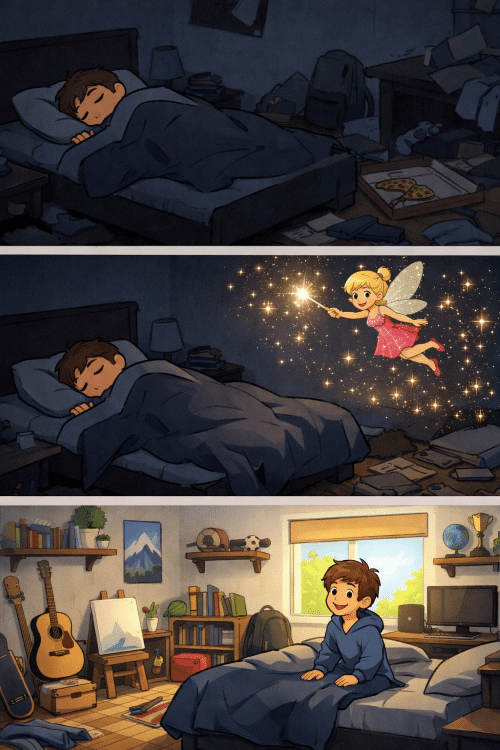
Imagining your Future
You may prefer to image your future by drawing it or using a vision board.
Create an image of a future you with how you want things to be.
You can draw a picture of your preferred future on paper or use the online Sketchpad.
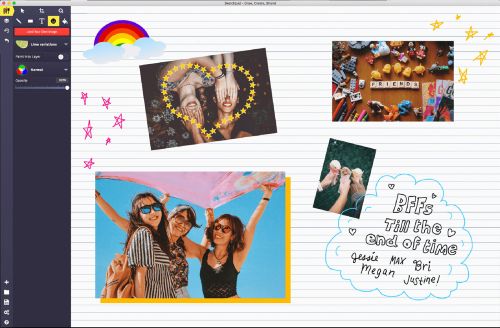
If you don’t like drawing, you could make an online Vision Board. You’ll need a google login. Then go to File -> Make a copy -> Selected Slide (If they've chosen one) -> Make copy. You can add your own images or use stock images from google slides. To do this go to: Insert -> Image -> Stock and Web -> Search

Social & Family Relationships – Taha Whānau
Techniques
GIVE Healthy Relationships
The GIVE acronym is used as way of communicating calmly and effectively. GIVE benefits your own self-esteem by treating others with respect, especially in difficult situations. It also leads to more positive self-respect and consequently positive self-image.
GIVE means be Gentle, Act Interested, Validate and use an Easy manner.
G - Gentle: Be respectful and kind. Avoid using threats, blaming, sarcasm, or judging. Do not resort to aggressive or manipulative behaviors, and skip judgmental body language (like eye-rolling or sneering).
I - Interested: Listen to the other person’s perspective completely. Make direct eye contact, put away distractions, and do not interrupt or talk over them. Show that you are actively engaged.
V - Validate: Acknowledge their feelings, opinions, and wishes. Try to see the world from their side and let them know that their emotions and reactions make sense, even if you don't necessarily agree with their stance.
E - Easy Manner: Approach the interaction with a laid-back, diplomatic tone. Use a little humor if it fits the situation, smile, and try to ease the tension instead of escalating it
Listen to Dr. Shireen Rizvi from the DBT Skills from Experts channel describe how to use GIVE. She’s a director at the Montefiore Medical Center.
Assertion & I-statements
Making I-statements is the basis of being assertive. An ‘I statement’ means owning your opinions, being direct, respectful and not blaming others.
You do this by instead of using you statements such as “You hurt me by always being late.” using an I-statement "I feel hurt when you are often late”.
Instead of describing your opinion as fact “Working in this place is impossible, no-one pulls their finger out and the company is going down the drain”, own your feelings “I find it really difficult working here, I think that some things don't get done that need to be done and I'm worried about the future of the organisation”.
And instead of disguising questions as statements, ““When are we going to make a decision?”, make a statement of what you want “Let’s make a decision now”.
Watch Unju from the The Counselling Group PL being assertive.
Using I Statements for Constructive Criticism
Constructive criticism is feedback aimed at improving others behaviour. It treats both people with respect. It provides specific suggestions rather than just pointing out faults.
Here is a formula for providing constructive criticism.
- A. Describehow you felt, or theeffect what they did had on you. Make it an observation not a conclusion about what they are, feel or think. “I felt… A (feeling)”
- B. Givea specific description of what they did or said. Avoid using the phrase ‘I feel that…’ asit’s a thought not a feeling. “when you did… B (behaviour)”,
- C. Saywhat it is that you object to or the consequences it had. “because of… C (reasons)”
- D. Saywhat you would like them to do or would have preferred to happen. “and I would like you to… D (alternative behaviour)”.
Example: “When you don’t finish our group project on time, I feel taken for granted because I want to do well on this. I would prefer that we could stick to the assigned timeline.”
Unju from the The Counselling Group PL shows how to do it.
Active Listening
A super effective way to build healthy relationships is learning to listen. It shows respect, fosters empathy and reduces conflict. It can even understand diverse viewpoints you may not have got otherwise.
To listening actively, do these four things.
Give your undivided attention. Block out any background noise or other distractions. Allow them to speak without interruption.
Follow their story. Focus on what they are saying. Do this by picking out the key points of their story. Repeat them back to yourself. Listen for both what is happening and how they feel. Encourage them to continue with small comments like yes, uh-huh, or maybe just a nod of the head. Avoid thinking of your opinion or your answer until they have finished talking.
Summarise the key points of what they said. Begin by using a phrase like, "this is what I heard" and "I think this is what you meant". Allow them to clarify any points you may have misjudged.
Avoid. Listen don’t think: Don’t judge, advise, or criticize. Don’t be thinking about what you’re going to say next. Concentrate on what they’re saying. These things stop you from listening.
Katie Owen’s short TED talk shows you how to do it.
Physical – Taha Tihana
Techniques
Exercise your way out of your funk
Sometimes when we feel stressed, low, or stuck in our thoughts, our bodies stay still for long periods. We sit on our phones, at school desks, or at home. When our bodies don’t move much, our mood can start to feel heavier too.
When you move your body, your brain releases feel good chemicals called endorphins. These chemicals can improve your mood, reduce stress, and help you feel calmer. When movement becomes part of your routine, it can be a powerful tool for protecting your mental wellbeing.
The great thing about exercise is that you have control over it, and can succeed, whereas you may have no control over your homelife, mood, school or relationships.
The END Goal
Any exercise is better than none, but Health NZ recommends at least 30 minutes of moderate physical activity per day (playing, gardening, cleaning), and to improve mood make it more vigorous (dancing, running, swimming).
Here’s some options for putting some exercise in your life.
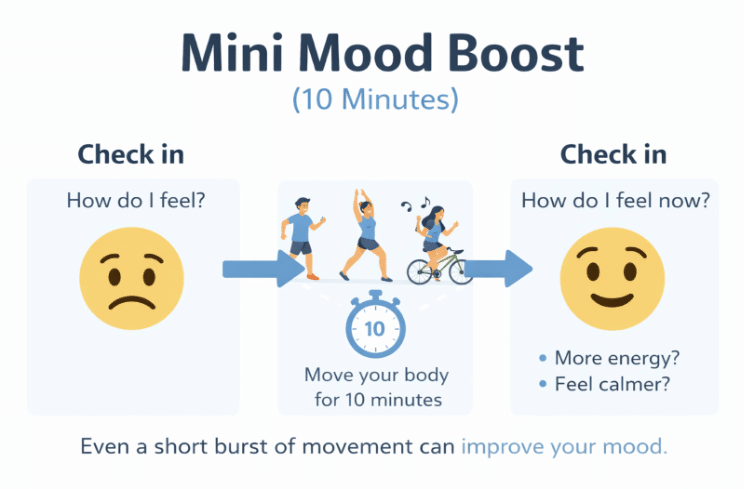
Mini Mood Boost
This activity helps you notice how movement can change how you feel. Many people notice they feel a little better after moving, even for a short time.
Pick a simple activity. Choose something easy such as walking, running, at home workout, stretching, dancing, shooting hoops, or riding a bike, etc.
Set a timer for 10 minutes, and Move your body (try to keep moving the whole time)
Check in with yourself. After the 10 minutes, ask yourself: How does my body feel? Has my mood changed at all? Do I feel more energized or calmer?
Just Dance
Why run around the park in shorts when you can dance? 30 minutes dancing gives you all the exercise you’ll need, especially as psychologist Dr. Peter Lovatt says super great for our mental wellbeing.
Search online for Just Dance + your favorite song. Play it and dance along following all the moves. Work your way up to 20 minutes most days. Better still, get your friends along and make it a party.
Free programmes
Nike Training Club. A free app from Nike sports shoes corporation with short workouts you can do at home without equipment.
Couch to 5k. A beginner running programme that slowly builds up fitness over 9 weeks from Britains National Health Service.
Parkrun. A free weekly 5km walk or run held in local parks, open to all fitness levels. Do it with others and meet people.
Keep up your Nutrition
How to get a good night’s Sleep
Research shows that good sleep doubles our chance of getting through our depression. That’s a higher hit rate than antidepressants. Great sleep means you wake up refreshed with energy and purpose.
Getting a great nights sleep comes from sleeping long enough and falling asleep in the first place.
When should I go to bed and how long should I sleep?
Use this Sleep Calculator to figure this out. Select the ‘When to Sleep’ button, Enter the time in the “What time do you need to wake up” entry box, Select the green ‘Calculate Bedtime’ button.
We found that the calculator by Women in Balance, a women and health-care professional education organisation was the easier to use.
Why this long? Sleep happens in 90 min cycles, and it's normal to wake up after each and then go back to sleep, mostly without remembering you woke up. Generally teens need about 6 cycles per night. 6 cycles is 9 hours. Children an extra cycle.
Healthy Sleep Habits - Create Your Bedtime Routine
If sleep is that important what can we do to get a better night’s sleep? Great sleep comes from developing a sleep routine and the habit reinforcement that bed equals sleeping.
This is about establishing the cognitive association, or habit, that you go do bed to sleep. That is what will get you to sleep in the long run.
This video will help you work out how to get great sleep habits. It’s from Britain’s National Health Service.
One. Set a Routine
Go to bed at a similar time. When’s your regular bedtime now. Start 30 minutes before that.
Remember - 2:00 PM no more caffeine (ask: how long does caffeine stay in your system? It has a half-life of 5 hours, so 10 hours to completely clear). Also no alcohol.
Two. Set a Relaxing Routine
30 minutes before bed start ritual. What will you do to relax? Reading, soft music, shower? No screens now, so where will you put your phone, or put on silent.
If worry about stuff while in bed recommend writing down your worries or doing a diary, and then write the next day’s task list. So you don’t have to think about these things.
Three. Sleep Hygiene
How will you make it dark. How will you make it Quiet? Do you need earplugs. Is your room a little cool.
Bed is just for sleeping. Not for reading, not for messaging. Go to bed, go to sleep. Form the habit.
Four. Most Effective Strategy when you can’t fall asleep
Get up, Read something boring, listen to soft music or do that a task list for tomorrow. Go back to bed when sleepy. Don’t force it.
This is hard. Especially if your house is cold over winter. But it’s the number one most effective strategy of training your mind that you go do bed to sleep.
Mental & Emotional – Advanced
Techniques
Butterfly Hugs
Star Hand Breathing
Star hand breathing (also known as starfish or 5-finger breathing) is a simple mindfulness technique that pairs deep, rhythmic breathing with the physical tracing of your hand. By combining sight, breath, and touch, it helps calm the nervous system and regulate emotions during moments of stress or anxiety.
How to do it
- Hold your hand out in front of you. Place your finger on the bottom of your thumb.
- Slowlybreathe inthrough your nose while tracing your finger up to the tip of the first finger on your hand.
- Pause.
- Slowly breathe out through your mouth while tracing your finger down the other side of your finger to the bottom.
- Pause.
- Slowlybreathe inthrough your nose while tracing your finger up to the tip of the second finger on your hand.
- Pause.
- Slowly breathe out through your mouth while tracing your finger down the other side of your finger to the bottom.
- Pause.
Repeat 3 more times (one for each finger)
10. Slowlybreathe inthrough your nose while tracing your finger up to the tip of the next finger on your hand.
11. Pause.
12. Slowly breathe out through your mouth while tracing your finger down the other side of your finger to the bottom.
13. Pause
Stomping
Catch, Check, Change
CBT Reframing
Survive & Thrive
To keep up your wellbeing you need to ensure that each part of your life is strong. If you are moving your body every day, treating others well, spending time with a trusted friend, learning more about what you enjoy and being kind to yourself, you will build your ability to cope with life.
Our Toolbox follows Te Whare Tapa Whā holistic wellbeing model with a section for each pou.
Long term mass population studies show that people who know and develop their strengths, have several positive friendships and are actively participating in society have far greater wellbeing and survive traumatic events better.

When Our Brain Flips Out
Most people can deal with everyday life stress. That’s when the pre-frontal cortex of our brain is functioning allowing us to use our rational and interpersonal skills.
However, for those of us who have experienced some trauma or extreme stress, our lower brain (limbic and amygdala) can take over putting us in survival mode. Here we are responding to a perceived threat and must act now, usually to either fight or flee. If we can’t do those, then we will freeze, flop or fawn. They are just stress responses and when they take over, it’s called flipping your lid, or the Amygdala hijack.
Hear from some experts from the Center of Trauma Research UK explain what happens.
Here is Ovilia Guy-Evans picture of an Amygdala Hijack on Simply Psychology.
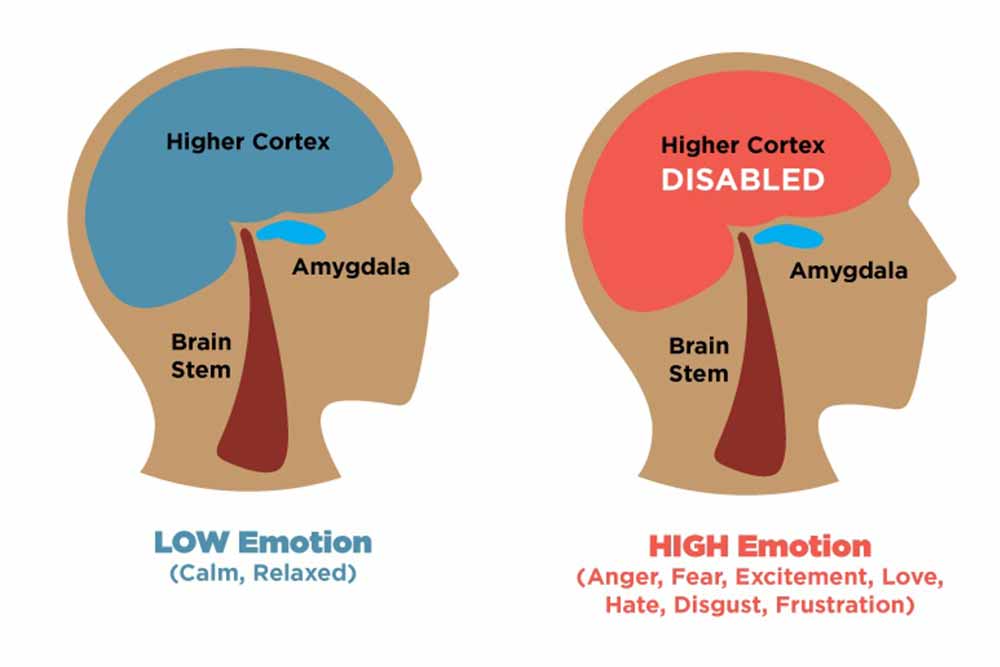
Survival mode shuts off our prefrontal cortex so we can’t make rational decisions or relate well with others. It's different for everyone. We like this chart by executive coach Paul Byrne, that suggests a range of stress responses.
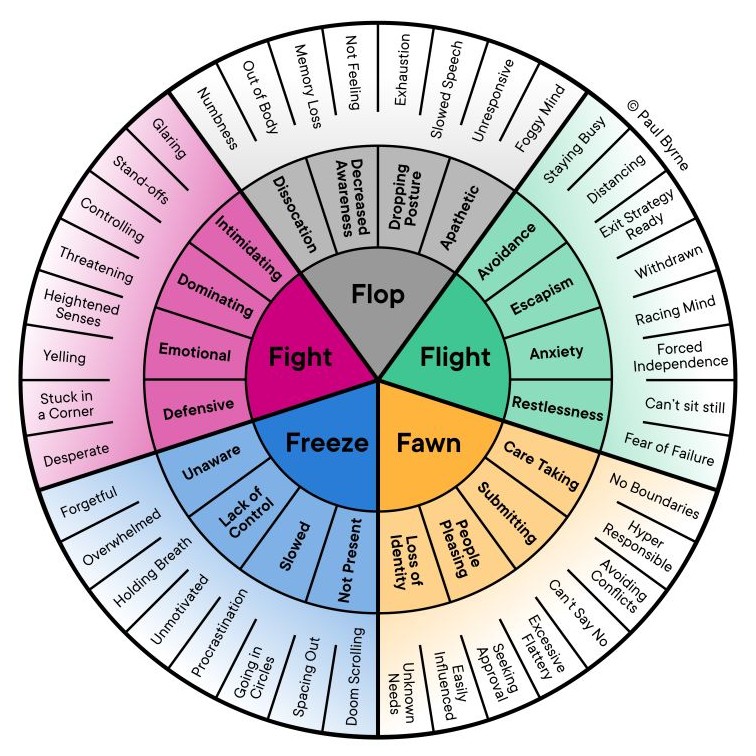
For some of us, any undue stress or anxiety generates fear and negativity that could result in your body triggering those defenses. This is because our mind thinks the trauma or extreme stress we experienced in the past is recurring.
We cannot resolve our issues or learn anything new while we’re in our stress response and our prefrontal cortex is offline.
To turn our prefrontal cortex back on, we need to: recognise it’s happened and try a strategy or tool to calm or ground ourselves. These techniques are in the Handling Heavy Feelings toolbox.
To reduce our lower brain from flipping out, we need to grow our resilience. That’s where practicing our wellbeing techniques come in.